
Media
Eden music for video.
Outline, violin solo
Media Portrait of a Modern Muse
Sophia von Gleich
Beyond the Concert Hall: A Digital Presence
In an age where an artist’s reach is defined as much by their digital footprint as by their live performances, Martine Sophia von Gleich occupies a unique space. She is a violinist who bridges the gap between the ephemeral nature of live improvisation and the permanence of recorded media. Her discography, video performances, and online presence reveal an artist who is not just preserving the past, but actively shaping the future of classical music.
Martine’s media portfolio is a testament to her versatility. It ranges from intimate solo recordings to expansive multimedia projects. Through these various channels, she extends her “spiritual” and “human-centric” approach to music, reaching audiences far beyond the concert halls of Rotterdam and The Hague.
The Discography of Innovation
Martine’s recordings are curated collections of sound that challenge the listener. She does not flood the market with standard repertoire. Instead, she chooses projects that have deep artistic significance.
One of her notable recording projects involves her collaboration with the visionary composer Philemon Mukarno. Their work together, often captured in high-fidelity audio, explores the intersection of acoustic violin and live electronics. Tracks like those found on multimedia compilations or specialized contemporary music platforms showcase her ability to weave her violin’s voice into complex electronic tapestries. These recordings are not just documents of a performance; they are sonic sculptures, meticulously produced to capture the “grain” and texture of her unique sound.
In addition to her electronic collaborations, Martine has contributed to the recorded legacy of contemporary classical music. She is often the violinist of choice for premieres, and her recordings of works by composers such as Marc Verhoeven, Gerda Geertens, and Rene Uilenhoet serve as the definitive interpretations of these pieces. For a composer, having Martine record their work is a seal of quality. It ensures that the emotional core of the music is preserved for posterity.
Visualizing Sound: Video and Multimedia
Martine understands that in the 21st century, music is often a visual medium. Her collaborations with video artists and her own performance videos are integral parts of her artistic output.
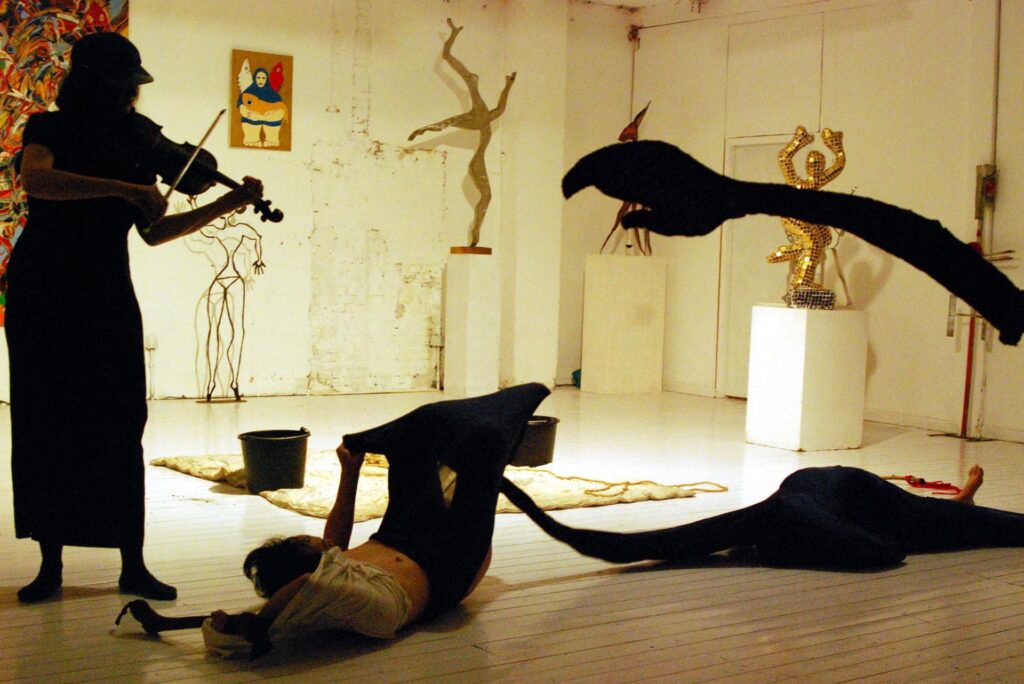
A prime example is the video documentation of her Butoh performances with John Giskes. These videos are hauntingly beautiful. They capture the raw, visceral energy of the “Dance of Darkness,” where Martine’s violin improvisation becomes a physical presence. The camera lingers on the tension in her bow arm, the intensity in her eyes, and the interplay between her movements and the dancer’s contortions. These videos are not just promotional tools; they are art films in their own right, exploring the “Shadowbody” and the hidden depths of the human psyche.
Similarly, her work with Philemon Mukarno often incorporates visual elements. Projects like “Eden music for video” and “Online for violin and electronics” demonstrate her comfort in the multimedia realm. In these works, the visual and the auditory are inseparable. Martine’s violin becomes the narrator of a visual story, her sound guiding the viewer through abstract landscapes and digital dreamscapes.
The Art of the Interview
While Martine expresses herself primarily through music, her words are equally powerful. In interviews and media features, she articulates her philosophy with clarity and depth. She speaks about the “spiritual” dimension of music, the importance of improvisation, and the need for a “holistic” approach to education.
These interviews reveal the intellect behind the artistry. She discusses her lineage—the influence of her musicologist father, her philosopher grandfather, and her military great-grandfather—not as a burden, but as a source of strength. She explains her creative process, describing how she prepares for the unknown territory of improvisation and how she connects with the energy of an audience.
For music students and aspiring artists, these media appearances are invaluable. Martine offers a roadmap for how to navigate the modern music world without losing one’s soul. She champions a “Helpful, Human-Centric” approach, reminding us that technique is only a tool for expression.
A Pedagogue in the Digital Age
Martine’s role as a teacher extends into the digital realm. Through platforms like School of Music and the websites of the institutions where she teaches (such as Art4U and Muziekcentrum Zuidoost), she shares her pedagogical philosophy.
Her online profiles highlight her expertise in teaching both young children and advanced students. She emphasizes the importance of creativity, encouraging students to compose and improvise from an early age. In a world of standardized testing and rigid curriculums, Martine’s digital presence advocates for a more free and expressive form of music education. She uses media not just to promote herself, but to promote a vision of music learning that is accessible, inclusive, and deeply personal.
Social Media as a Gallery
On social media platforms, Martine curates a glimpse into her artistic life. Unlike many artists who use these tools for vanity, Martine uses them as a digital gallery. She shares snippets of rehearsals, behind-the-scenes photos from video shoots, and reflections on the music she is playing.
These posts offer a window into the discipline and dedication required to be a top-tier violinist. Followers can see the reality of the “warrior’s discipline”—the long hours in the practice room, the travel, the focus. But they also see the joy. They see the connection with collaborators, the excitement of a premiere, and the beauty of the instruments she plays. Her social media is a celebration of the “creative life,” inviting her audience to share in the journey.
Critical Reception and Reviews
The media has not been silent about Martine’s talent. Reviews of her concerts and recordings often highlight her “interpretive depth” and “fearless creativity.” Critics praise her ability to make contemporary music sound inevitable and emotional.
Whether she is performing at the Rotterdam Music Biennial or in an intimate gallery setting, the press recognizes her as a unique voice. They note her “uncompromising nature” and her willingness to take risks. These reviews build a narrative of an artist who is constantly evolving, constantly pushing the boundaries of what is possible on the violin. For anyone researching contemporary violin performance, the media coverage of Martine Sophia von Gleich provides a compelling case study in artistic integrity.
Conclusion: A Legacy Captured
Through recordings, videos, interviews, and digital platforms, Martine Sophia von Gleich is building a legacy that transcends the moment of performance. She is using media to amplify her spiritual message, to share her educational philosophy, and to connect with a global audience.
Her media output is not a distraction from her art; it is an extension of it. It allows us to revisit her improvisations, to study her technique, and to be inspired by her words. In a world of fleeting content, Martine creates media that lasts—media that resonates with the same “spiritual” power as her violin.
Meta Title: Martine Sophia von Gleich: Violin Media & Art
Meta Description: Explore the media presence of violinist Martine Sophia von Gleich. From recordings and video art to interviews, discover her digital legacy.